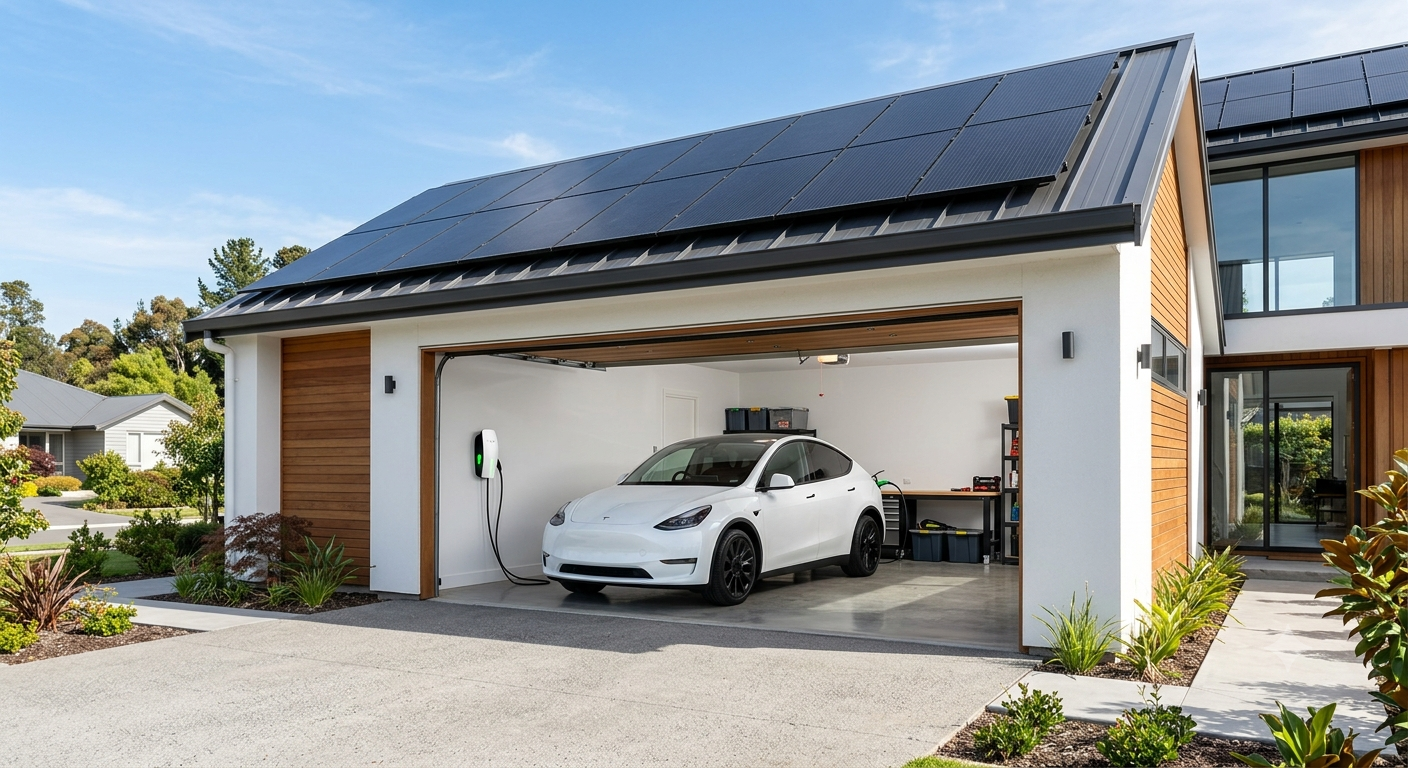
If you own or are considering a Tesla Model Y, one of the most useful solar questions is simple: how many solar panels do you need to charge the car at home?
The answer depends on your Model Y version, driving mileage, charging losses, local sunshine and the size of the solar panels. For a practical 2026 planning example, this guide uses a 74 kWh usable battery reference for a Model Y Long Range configuration and also shows how the answer changes with daily driving.
Tesla Model Y Battery and Solar Energy Requirement
Battery capacity varies by Model Y version and model year. As a planning reference, a current Model Y Long Range RWD specification is listed at about 74 kWh usable capacity. Real-world energy required from the wall can be higher because charging is not 100% efficient.
For solar planning, it is better to calculate from your daily miles rather than assume that you empty and refill the entire battery every day.
| Daily driving | Example EV energy use* | Approx. solar energy needed after charging losses |
|---|---|---|
| 20 miles | ~6 kWh/day | ~6.6 kWh/day |
| 40 miles | ~12 kWh/day | ~13.2 kWh/day |
| 60 miles | ~18 kWh/day | ~19.8 kWh/day |
| 80 miles | ~24 kWh/day | ~26.4 kWh/day |
*Planning example using approximately 300 Wh/mile. Actual Model Y consumption varies with speed, weather, tires, temperature, HVAC use and driving conditions.
How Many 630W Solar Panels Do You Need?
A 630W panel has a nameplate capacity of 0.63 kW. The panel does not produce 630 watts continuously; daily and annual production depend on location, orientation, shading, temperature and system losses.
For a simple U.S. planning calculation, assume a 630W panel produces around 2.5–3.0 kWh per day on average across the year in a good solar location. This is an estimate for planning, not a guaranteed output.
| Daily Model Y driving | Approx. EV solar energy/day | 630W panels, planning range | Nominal solar size |
|---|---|---|---|
| 20 miles | ~6.6 kWh | 3–4 panels | 1.89–2.52 kW |
| 40 miles | ~13.2 kWh | 5–6 panels | 3.15–3.78 kW |
| 60 miles | ~19.8 kWh | 7–8 panels | 4.41–5.04 kW |
| 80 miles | ~26.4 kWh | 9–11 panels | 5.67–6.93 kW |
The table is intentionally a planning range. In a weaker solar location or during winter, you may need more panels. In a high-production location, fewer panels may cover the same annual EV energy.
What Size Solar System Is Best for a Tesla Model Y?
If you are installing solar only to offset the Model Y, a roughly 3–7 kW array can cover many daily-driving patterns. But most homeowners should not size the entire solar system around the EV alone.
| Solar system | 630W panels | Good fit for |
|---|---|---|
| 3.15 kW | 5 panels | Light-to-moderate daily Model Y driving |
| 3.78 kW | 6 panels | About 40 miles/day in a good solar location |
| 5.04 kW | 8 panels | Higher daily mileage or weaker production |
| 6.30 kW | 10 panels | Heavy driving plus additional solar headroom |
| 10.08 kW | 16 panels | Home + EV solar system planning |
Tesla Wall Connector: How Fast Can a Model Y Charge?
Tesla's current Wall Connector can provide up to 11.5 kW / 48 amps on a suitable 60-amp circuit. Tesla lists up to 44 miles of range per hour for Model Y at that maximum configuration. However, some current Model Y configurations are limited to 32 amps / 7.7 kW, so the vehicle and electrical installation determine the actual charging rate.
| Circuit | Wall Connector output | Model Y max range added per hour* |
|---|---|---|
| 60A | 11.5 kW | Up to 44 miles/hour |
| 50A | 9.6 kW | Up to 37 miles/hour |
| 40A | 7.7 kW | Up to 30 miles/hour |
| 30A | 5.7 kW | Up to 22 miles/hour |
| 20A | 3.8 kW | Up to 15 miles/hour |
*Tesla's published maximum range-per-hour figures. Actual charging speed depends on vehicle configuration, battery state, temperature and electrical conditions.
Can Solar Panels Charge a Tesla Directly?
Yes, but not by connecting rooftop panels directly to the Tesla. A normal residential setup looks like:
A smart energy-management system can prioritize daytime EV charging when solar production is high. If the car is parked at home during the day, this can increase direct solar consumption and reduce grid electricity purchases.
How Much Does It Cost to Fully Charge a Tesla Model Y?
For an apples-to-apples example, we use 74 kWh as the battery energy reference. Actual billed energy can be higher because charging losses, battery conditioning and station billing rules vary.
| Charging option / network | 2026 reference rate | 74 kWh energy cost | Important note |
|---|---|---|---|
| Home electricity — U.S. reference | ~$0.184/kWh | ~$13.62 | Residential reference; utility rate varies |
| IONNA | ~$0.39/kWh | ~$28.86 | Reference network rate; station pricing can vary |
| Tesla Supercharger — Tesla driver/member reference | ~$0.433/kWh | ~$32.04 | Location and time can change price |
| Electrify America — Pass+ reference | ~$0.46/kWh | ~$34.04 | Pass+ pricing reference; app shows live station price |
| ChargePoint DC fast — reference | ~$0.48/kWh | ~$35.52 | Host sets price; some sessions add fees |
| Shell Recharge — U.S. network average | ~$0.48/kWh | ~$35.52 | Network average; station-specific pricing varies |
| EV Connect — public DC fast reference | ~$0.53/kWh | ~$39.22 | Public DC fast charging varies by site |
| EVgo — pay-as-you-go average | ~$0.644/kWh | ~$47.66 | Location, plan and time of day affect price |
| Tesla Supercharger — non-Tesla/no-membership reference | ~$0.601/kWh | ~$44.47 | Illustrative 2026 reference; Tesla station pricing is dynamic |
| AAA U.S. public charging average | $0.420/kWh | ~$31.08 | All commercial/public charging levels combined |
Public charging prices are not universal network-wide fixed rates. Networks such as Electrify America, ChargePoint and EVgo state that pricing can vary by location, plan, time of day and station. Check the network app or charger screen before charging. The calculations above multiply the reference rate by 74 kWh and exclude taxes, session fees, idle fees and charging losses.
What About Other U.S. Charging Networks?
There are many more charging networks in the United States, including Blink, FLO, Francis Energy and regional operators. Their prices are often host- or location-controlled, so a single national per-kWh number can be misleading. For example, ChargePoint explicitly says station owners or roaming partners set pricing, and rates can be per kWh, per hour, flat fee or subject to other fees.
For that reason, the table above uses representative 2026 reference rates where credible network-level data is available rather than pretending every station has one nationwide price.
Is Charging a Tesla at Home Cheaper Than Public Charging?
Usually, yes. AAA's September 8, 2026 U.S. average for commercial/public EV charging is about $0.420/kWh, while a May 2026 U.S. residential electricity reference used in current charging-price analysis is about $0.184/kWh. That makes home electricity dramatically cheaper than many DC fast-charging sessions.
Solar can reduce the marginal electricity purchase even further because the homeowner is using electricity generated by their own solar array. The solar system still has an upfront cost, so “free charging” should be understood as low marginal fuel cost after solar installation, not zero total ownership cost.
Tesla Model Y vs Gasoline Car: Which Is Cheaper to Fuel?
For a simple comparison, use a gasoline vehicle that averages 30 mpg and a Tesla Model Y that consumes about 300 Wh/mile in our planning example.
| Energy source | Example cost | Approx. cost per 100 miles |
|---|---|---|
| Tesla Model Y — home electricity at $0.184/kWh | $0.184/kWh | ~$5.52 |
| Tesla Model Y — public charging at $0.420/kWh | $0.420/kWh | ~$12.60 |
| Tesla Model Y — EVgo example | $0.644/kWh | ~$19.32 |
| Gas car — 30 mpg at $4.151/gal | $4.151/gal | ~$13.84 |
| Tesla Model Y — solar-generated electricity | Marginal energy cost can be very low after solar is installed | Depends on solar system economics |
AAA's national regular-gasoline average was about $4.151 per gallon on September 8, 2026. At 30 mpg, that is about $13.84 of gasoline for every 100 miles. Under the assumptions above, home-charged Model Y energy costs substantially less, while expensive public DC fast charging can approach or exceed gasoline on a per-mile basis.
How Much Can Solar Save Compared With Gasoline?
Imagine driving 15,000 miles per year. At 300 Wh/mile, the Model Y would require about 4,500 kWh of vehicle energy before additional charging losses.
| Fuel scenario | Approx. annual energy/fuel cost |
|---|---|
| Model Y at $0.184/kWh | ~$828 |
| Model Y at $0.420/kWh public average | ~$1,890 |
| Gas car at 30 mpg and $4.151/gal | ~$2,076 |
| Model Y using solar electricity | Depends on solar installation and financing costs |
This is an energy-cost comparison only. It does not include vehicle purchase price, insurance, maintenance, tires, charging hardware, solar installation, financing or depreciation.
Best Solar + Tesla Model Y Setup in 2026
For a homeowner who drives roughly 40 miles per day, a practical starting point is a 5–6 panel 630W EV-only array in a good solar location. That is about 3.15–3.78 kW of nameplate solar capacity.
If the same rooftop system will power the house, air conditioning, appliances and the Model Y, consider the entire household load rather than adding only five or six panels. A 10 kW-class home solar system, for example, has much more room to offset both household electricity and EV charging, subject to local production and utility rules.
Daytime Solar Charging vs Night Charging
Daytime charging
Best when the Model Y is parked at home while solar production is strong. You can use more of the solar electricity directly instead of exporting it and later buying electricity back.
Night charging
Useful when the vehicle is away during the day. A home battery can shift some daytime solar into evening charging, but battery losses and the battery's cost should be considered.
Smart charging
A smart charging schedule can coordinate the Wall Connector with solar production, household demand and utility time-of-use rates. This can be more valuable than simply installing the largest possible EV solar array.
Frequently Asked Questions
How many 630W solar panels do I need for a Tesla Model Y?
For around 40 miles of daily driving, roughly 5–6 630W panels is a reasonable planning range for the EV alone in a good U.S. solar location. Actual needs vary by climate, driving efficiency and charging losses.
Can six 630W panels charge a Tesla Model Y?
Six panels equal 3.78 kW of nameplate solar capacity. They can produce enough annual energy for many moderate-driving patterns, but daily production is not constant and winter output can be much lower.
Is Tesla Wall Connector worth it?
For a homeowner who wants convenient daily charging, it can be. Tesla lists up to 11.5 kW and up to 44 miles of range per hour under the maximum supported configuration, while some Model Y configurations are limited to 7.7 kW.
Is Tesla charging cheaper than gasoline?
Home charging is usually cheaper per mile under the assumptions in this guide. Public DC fast charging can be much more expensive, and at some rates it can approach or exceed the fuel cost of an efficient gasoline vehicle.
Can solar make Tesla charging free?
Solar can greatly reduce the electricity you purchase for charging, but the solar system has an upfront cost. The more accurate description is low-marginal-cost charging after the solar system is installed.
Bottom Line
For a Tesla Model Y driver, solar and home charging can work extremely well together. If you drive around 40 miles per day, a starting point of 5–6 × 630W solar panels can cover a large share of the EV's annual energy requirement in a good solar location. Drivers with higher mileage or weaker solar production may need 7–11 panels or more.
The Tesla Wall Connector then turns that solar-generated electricity into convenient home charging, with up to 11.5 kW / 48A output under the appropriate electrical setup. Public charging remains useful for road trips, but home solar charging can be substantially cheaper than both public DC fast charging and gasoline fuel costs.
SolarRateHub will continue tracking solar, EV charging and energy-cost comparisons for U.S. homeowners.
Sources & 2026 Pricing Notes
- Tesla Wall Connector specifications: Tesla Support — up to 11.5 kW / 48A and up to 44 miles of range per hour depending on vehicle configuration.
- Tesla Home Charging: Wall Connector and Mobile Connector charging information.
- AAA Fuel Prices — U.S. gasoline and public EV charging averages, checked September 8, 2026.
- ChargePoint — station owners/roaming partners determine individual charging prices.
- Electrify America — pricing varies by station, plan and energy delivered; current price is shown in the app/charger.
- EVgo — pricing varies by region, plan and time of use.
- 2026 U.S. charging-price market data used for representative network comparisons; always confirm the live station price before charging.