Jetour T2 i-DM PHEV Solar Charging Guide 2026: How Much Solar Power Do You Need?
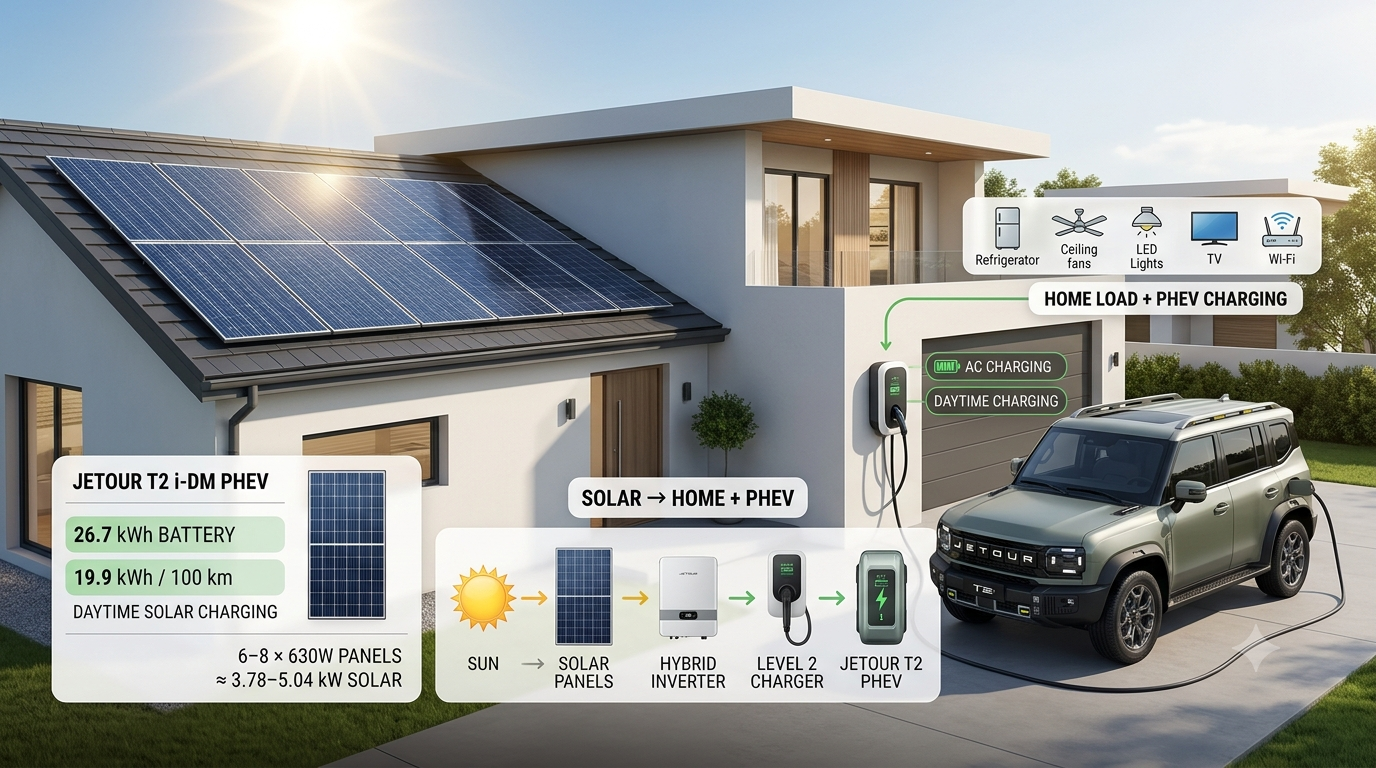
The Jetour T2 i-DM is a plug-in hybrid SUV, so it can use electricity for daily driving while keeping its gasoline powertrain for longer trips. That makes it an interesting match for a home solar system: instead of treating the vehicle as a conventional EV, homeowners can use daytime solar production to cover household loads and recharge the PHEV battery.
This guide looks at the Jetour T2 PHEV battery capacity, charging speed, electric range, compatible charging options and solar panel requirements. Because T2 i-DM specifications vary by market, the main calculation below uses the 2026 UAE/GCC specification with a 26.7 kWh battery. Other markets may use different battery or charging configurations.
Jetour T2 i-DM PHEV: Key Charging Specifications
| Specification | 2026 reference |
|---|---|
| Vehicle type | Plug-in hybrid (PHEV) |
| Battery chemistry | LiFePO₄ |
| Battery energy | 26.7 kWh |
| Electric consumption | 19.9 kWh/100 km |
| WLTC pure-electric range | 100 km |
| CLTC pure-electric range | 129 km |
| Fast charging | 30–80% in about 0.5 hour |
| Slow charging | 30–100% in under 4 hours |
Jetour UAE's 2026 specification sheet lists a 26.7 kWh LiFePO₄ battery, 19.9 kWh/100 km electricity consumption, 100 km WLTC pure-electric range and 30–80% fast charging in about 30 minutes. It lists slow 30–100% charging at under four hours. citeturn0search48
How Much Electricity Does a Jetour T2 PHEV Need?
Using the 19.9 kWh/100 km reference consumption, the approximate electricity needed for different daily driving distances is:
| Daily electric driving | Approx. vehicle energy |
|---|---|
| 25 km | ≈ 5.0 kWh |
| 50 km | ≈ 10.0 kWh |
| 75 km | ≈ 14.9 kWh |
| 100 km | ≈ 19.9 kWh |
These are energy-use estimates, not wall-to-battery charging figures. Real charging from the grid or solar system will require additional energy because of charging and conversion losses.
How Many 630W Solar Panels Are Needed?
SolarRateHub uses 630W Tier-1 panels as a practical comparison baseline. A panel produces 630W under its rated test conditions; actual output varies with sunlight, temperature, orientation, shading and system losses.
| 630W panels | Array size | Best use |
|---|---|---|
| 6 | 3.78 kW | Primarily PHEV daytime charging with modest household load |
| 8 | 5.04 kW | PHEV charging plus basic daytime home loads |
| 10 | 6.30 kW | More comfortable daytime charging and household headroom |
| 12 | 7.56 kW | Strong option for PHEV + larger daytime home load |
For a driver covering around 50 km of electric driving per day, the T2's reference consumption works out to about 10 kWh of vehicle energy. An 8–10 panel array (5.04–6.30 kW DC) gives a more practical starting point than sizing the system only from the battery's 26.7 kWh nameplate capacity.
Best Solar Setup for Daytime Jetour T2 Charging
If the goal is to charge the T2 mainly during daylight, the ideal energy flow is:
The advantage of daytime charging is that the vehicle can use solar electricity directly while the panels are producing. This can reduce unnecessary battery cycling and can allow a smaller home battery than a setup that tries to charge the vehicle overnight.
What Charging Station Should You Use?
For a residential solar setup, a properly installed AC Level 2 wallbox is the most sensible category to evaluate. The exact maximum charging power should match the local T2 variant, its onboard charger and the home's electrical service.
- Level 1: Slow and generally unsuitable if you want regular daytime solar replenishment.
- Level 2: The practical home option for scheduled daytime charging.
- DC fast charging: Useful for road trips and rapid 30–80% charging, but normally not the right choice for a standard residential solar installation.
What Solar Inverter Size Makes Sense?
For a T2-only solar charging setup, a 5–8 kW hybrid inverter class can be a reasonable planning range depending on the solar array and household load. If the same system also needs to run multiple air conditioners and other heavy appliances while charging the vehicle, a larger inverter may be appropriate.
Remember that solar array kW and inverter AC kW are different measurements. A 6.30 kW solar array does not mean the home can continuously draw 6.30 kW from solar at every moment of the day.
Do You Need a Home Battery?
Not necessarily. If the T2 is normally parked at home during strong solar-production hours, direct daytime charging can reduce the need for a large battery. A battery becomes more valuable when the vehicle returns home in the evening, when nighttime home loads are significant, or when backup power is a priority.
Example: T2 + Basic Home Load
Suppose a home uses about 1.5–2.5 kW during the day and the T2 is being charged at the same time. A 6.30–7.56 kW solar array gives useful headroom for the home and vehicle during good solar conditions. The exact charger power can be scheduled dynamically so that the EV reduces its charging rate when household demand rises or solar production falls.
Final Takeaway
The Jetour T2 i-DM PHEV can work well with a daytime solar strategy because it combines a rechargeable battery with a gasoline powertrain for longer journeys. For the 26.7 kWh reference specification, an 8–12 × 630W panel system (5.04–7.56 kW DC) is a useful planning range for PHEV charging, with the final size determined by daily driving, local solar conditions and the home's electricity demand.
If the home also runs multiple air conditioners or other high-power appliances while the T2 charges, move toward a larger solar array and inverter rather than sizing the system only for the vehicle.
Always verify the exact Jetour T2 i-DM variant, charging connector, onboard charger rating, electrical service and local installation requirements before purchasing a wallbox or solar equipment.
Sources: Jetour UAE 2026 T2 i-DM specification sheet; Jetour Europe i-DM charging information. Specifications can vary by market and model year.