 SolarRateHub
NEWS · August 28, 2026
GTA 6 vs Solar Panels: How Big Is the Difference?
Grand Theft Auto VI and solar panels may seem like completely different worlds, but their financial scale makes for a surprisingly useful comparison. One is a blockbuster entertainment project; the other is part of a global energy industry.
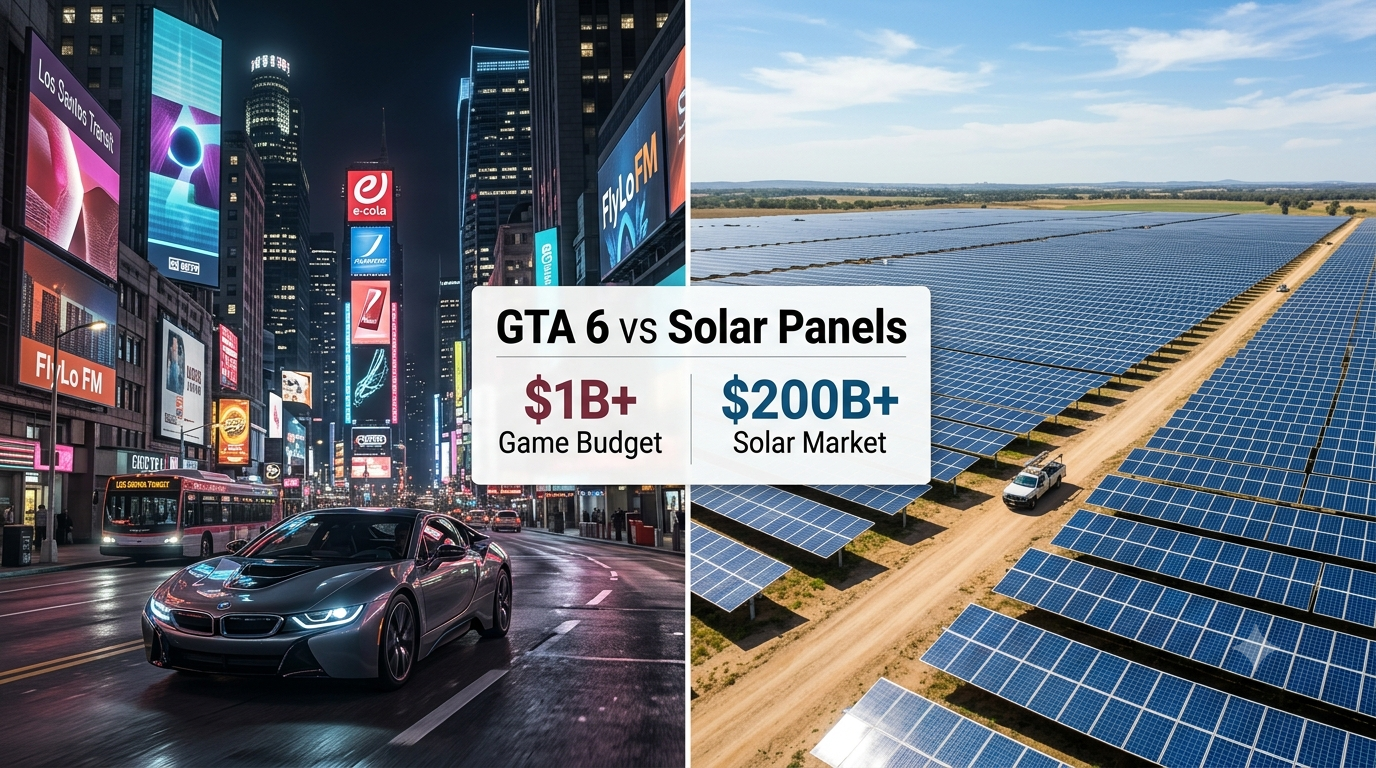
First, an important fact about the GTA 6 budget
Rockstar Games and parent company Take-Two Interactive have not publicly disclosed an official GTA 6 development budget. Online reports frequently cite figures around $1 billion to $2 billion, but those numbers should be treated as estimates rather than confirmed company figures.
Recent reporting describes a high-hundreds-of-millions development cost as plausible, with a total investment above $1 billion possible when development, marketing and launch-related spending are considered. The widely repeated $2 billion figure remains unverified.
How does that compare with the solar panel market?
The comparison becomes dramatic when a possible billion-dollar GTA 6 investment is placed beside the global photovoltaic industry. The solar PV market operates at a completely different scale because it includes manufacturing, modules, supply chains and installations serving households, businesses and utility projects worldwide.
That means even a $1–2 billion estimated GTA 6 investment would represent only a small fraction of the annual global solar market. It would be misleading to say GTA 6 is worth more than solar panels or that the game has a market value equal to the solar industry.
GTA 6 vs Solar: Simple Scale Comparison
| Item | Approximate scale | Status |
|---|---|---|
| GTA 6 possible total investment | $1B–$2B+ range discussed publicly | Estimated, not officially disclosed |
| Global solar PV industry | Hundreds of billions of dollars annually | Industry market estimate |
| GTA 6 share at $1B | A small fraction of global solar market | Illustrative comparison |
The comparison uses different economic measures: a possible project investment versus an industry-wide market. They are not directly equivalent.
Why the comparison is interesting for the US
The United States is one of the world's major solar markets, while GTA 6 is expected to be one of the biggest entertainment launches of 2026. For US consumers, the contrast shows how different industries can generate enormous economic activity from very different products.
A single blockbuster game can require years of software development, technology, artists, testing and marketing. Solar, by contrast, involves physical manufacturing at huge scale, international logistics, project development, installation labor and decades of electricity generation.
Could GTA 6 recover a billion-dollar investment?
That is possible, but it depends on sales, pricing, platform fees, marketing costs and long-term revenue from online services. GTA V demonstrated the earning potential of the franchise, but GTA 6's future financial performance cannot be known before launch.
What this means for SolarRateHub readers
The comparison is not about choosing games over renewable energy. It is a way to understand scale. A billion-dollar entertainment project sounds enormous, yet global solar manufacturing and deployment operate at a vastly larger industrial level.
More SolarRateHub: USA Solar Panel Prices 2026 · China Solar Panel Prices · Solar Calculator
Disclaimer
GTA 6 budget figures are estimates reported by third parties and are not an official Rockstar Games or Take-Two budget disclosure. Solar market figures are industry estimates and may vary by source, geography, product definition and measurement period. This article is for informational purposes and should not be interpreted as a direct valuation of either GTA 6 or the solar industry.
Sources
- Take-Two Interactive corporate information
- InfoLink Consulting solar market data
- Recent 2026 reporting on GTA 6 budget estimates